Basildon’s rapid expansion from a cluster of villages into a post-war New Town transformed more than just the skyline. The 1949 masterplan placed heavy infrastructure onto a layered substrate that transitions abruptly between London Clay, silty Thanet Sand, and pockets of flint gravel. Each formation behaves differently under load, and the boundary zones where they meet create subtle but consequential shear contrasts. Test pits excavated across the Laindon and Pitsea areas consistently expose these interfaces within the top four metres, confirming that shallow foundations require unit-specific bearing verification rather than generic assumptions. In the Vange and Five Links districts, where housing was accelerated on reclaimed brickearth, seasonal moisture fluctuation introduces shrink-swell potential that a desk study alone cannot quantify. A soil mechanics study in Basildon becomes the only reliable basis for determining effective stress parameters, consolidation settlement, and the long-term stability of cut slopes that punctuate the town’s undulating terrain.
Basildon’s London Clay routinely shows a plasticity index above 35%, demanding foundation designs that accommodate significant seasonal volume change rather than relying on typical bearing capacity tables.
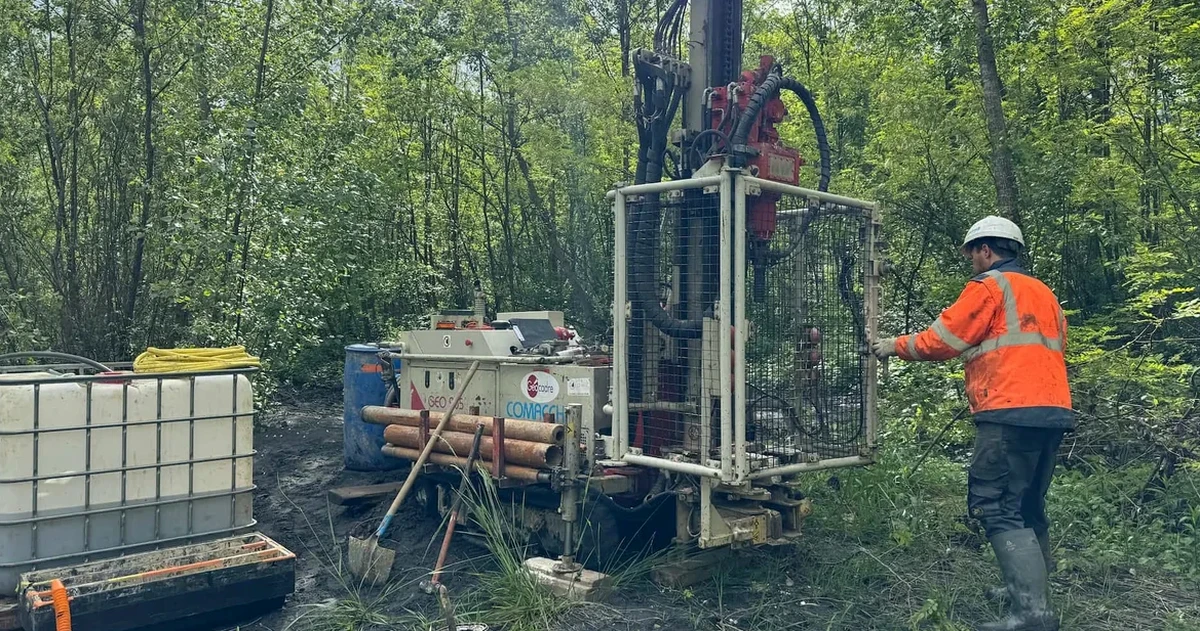
Methodology applied in Basildon
Risks and considerations in Basildon
BS 5930:2015+A1:2020 and Eurocode 7 (BS EN 1997-1:2004+A1:2013) require that ground investigation be sufficient to establish a geotechnical model, yet in Basildon the model is complicated by anthropogenic deposits that were placed without engineered control during the post-war construction boom. These made-ground layers, often two to four metres thick, contain variable proportions of chalk rubble, brick fragments, and reworked clay, creating a heterogeneous mass that drains unpredictably and can mask dissolution features in the underlying Chalk where it rises near the southern fringe of the borough. The National Soil Map (Soilscapes 6 and 8) records slowly permeable, seasonally wet soils across much of the district, which means that a soil mechanics study in Basildon must explicitly assess pore water pressure conditions and their influence on effective stress for both shallow and piled foundation solutions. Missing this step has led to differential settlement in several local authority housing blocks, where the transition from gravel onto clay was not adequately profiled before construction.
Our services
The laboratory testing programme is designed to extract the specific parameters that local structural engineers need for foundation and earthworks design on Basildon’s variable drift geology. Every test package is configured to the units encountered in the borehole log, so the data feeds directly into a ground model rather than sitting as isolated index values.
Triaxial and shear box testing
Consolidated-undrained and drained tests on London Clay and Thanet Sand to define the Mohr-Coulomb failure envelope under site-specific stress paths, including measurement of pore pressure response during shearing.
One-dimensional consolidation (oedometer)
Incremental loading tests to determine compression index, coefficient of consolidation, and preconsolidation pressure, enabling settlement magnitude and rate calculations for clay strata beneath proposed embankments or foundations.
Chemical and sulfate analysis
BRE SD1 classification suites on soil and groundwater samples to specify concrete design class and protective measures, critical in Basildon where made ground frequently returns elevated sulfate and pH values.
Common questions
How much does a soil mechanics study cost for a typical Basildon residential plot?
For a standard single-plot investigation including borehole drilling, laboratory triaxial and classification tests, and a factual report with geotechnical parameters, costs in the Basildon area generally range from £2,760 to £4,610 depending on access constraints and the depth of made ground encountered.
What depth of investigation is required under Basildon building control guidance?
Building control typically expects boreholes to extend through the full thickness of made ground and at least three metres into competent natural strata. Where London Clay is the bearing layer, the depth must also be sufficient to assess the zone of seasonal moisture influence, usually the top 1.5 to 2.0 metres of the clay profile.
Can you test for sulfate attack risk in the soil and groundwater?
Yes, the laboratory programme includes BRE Special Digest 1 sulfate suite analysis on both soil and water samples. This determines the Design Sulfate Class and the corresponding concrete quality and protective measures required for buried elements in contact with Basildon’s often aggressive made-ground deposits.