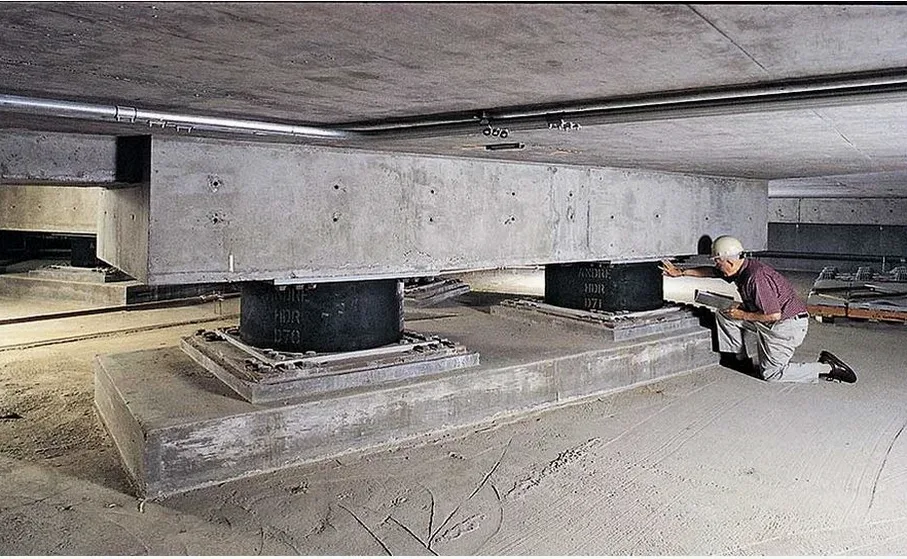
Eurocode 8 Part 1 (BS EN 1998-1:2004) frames seismic design requirements across the UK, and Basildon’s geology demands careful attention. The town sits over London Clay with pockets of alluvium and gravel, creating Site Class D or E conditions that amplify ground motion. A conventional fixed-base design struggles here. The building moves with the ground. Cracks appear. Services disconnect. Base isolation seismic design decouples the structure from the soil, inserting flexible bearings that absorb energy before it reaches the frame. For a hospital extension or a data centre near the A127, this approach transforms seismic risk into a manageable engineering parameter. The technical team applies nonlinear time-history analysis using site-specific spectra developed from MASW testing and borehole data, ensuring the isolation system matches the actual stratigraphy, not a generic code spectrum.
An isolation system is only as good as the ground it sits on. Site-specific spectra beat generic assumptions every time.
Methodology applied in Basildon
Risks and considerations in Basildon
A four-storey mixed-use block in central Basildon, built in the 1990s with fixed-base concrete frames, underwent a recent seismic assessment. The analysis showed inter-storey drifts exceeding 2.5% under the MCE scenario. Contents would slide. Partitions would fail. The retrofit study concluded that base isolation seismic design, applied via a transfer slab above new bearings, cut drift to under 0.5%. The isolation period shifted from 0.4 seconds to 2.5 seconds, well outside the amplified range of the soft clay. Without this intervention, the building faced functional obsolescence. The lesson applies broadly: structures on London Clay in the Thames Basin benefit disproportionately from period-shift strategies. Ignoring soil-structure interaction leads to costly underestimation of displacement, especially where clay thickness varies sharply across the site.
Our services
The isolation design process integrates geotechnical investigation, structural dynamics, and device specification into a single workflow.
Isolation System Design & Analysis
Nonlinear time-history analysis with site-specific spectra. Bearing selection, moat detailing, and peer review against BS EN 15129. Applicable to new-build and retrofit projects in Basildon.
Site-Specific Seismic Hazard Assessment
MASW and borehole campaigns to determine Vs30 and site class. Development of design response spectra per BS EN 1998-1, including soil amplification effects from London Clay and alluvial deposits.
Common questions
What does base isolation seismic design cost for a typical building in Basildon?
The design package for a small to medium commercial building in Basildon ranges from £2,930 to £6,400, depending on the number of analysis runs, bearing types evaluated, and peer review requirements. This covers the isolation system design, time-history analysis, and specification package.
Is base isolation mandatory under UK building regulations for Basildon?
No. It is not mandatory. However, for Importance Class III and IV structures (hospitals, emergency centres, critical infrastructure), BS EN 1998-1 strongly encourages or requires enhanced seismic performance that base isolation delivers efficiently.
Which bearing type works best on London Clay in Basildon?
Lead-rubber bearings (LRB) and high-damping rubber bearings (HDRB) both perform well. The choice depends on the required damping and re-centering capability. Friction pendulum systems (FPS) are also evaluated when longer periods are needed. The soil profile from the specific Basildon site drives the final selection.
How long does the design process take?
From site investigation to final specification, allow four to six weeks. This includes the geophysical survey, time-history analysis, bearing design iterations, and peer review. Retrofit projects on existing Basildon structures may require additional survey time.