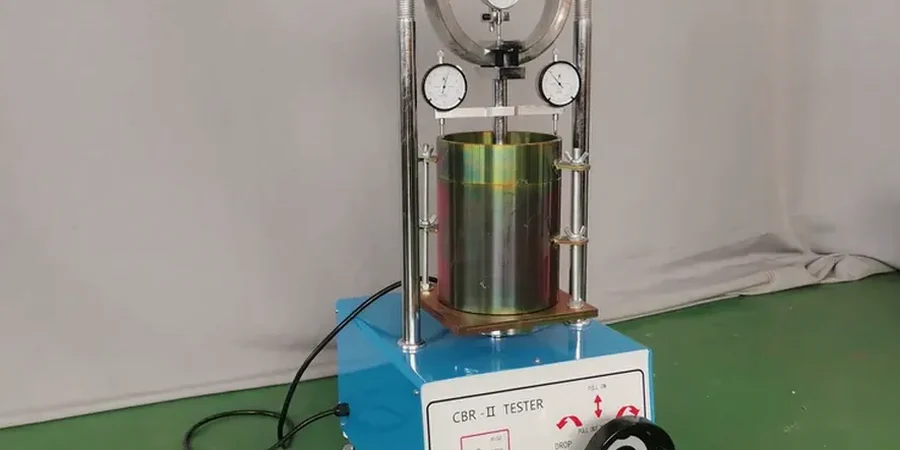
You only have to look at a map to see why Basildon demands a careful approach to subgrade evaluation. The heavy clays around Laindon and Langdon Hills behave nothing like the chalky deposits you encounter near Pitsea. In our experience, a road design that works on the higher ground will fail prematurely down by the marshes if you assume the same bearing strength. That is where the laboratory CBR test becomes essential. We run soaked CBR specimens in our accredited lab using BS 1377-4:1990, measuring how a compacted sample holds up after four days of immersion, which simulates the worst winter groundwater conditions Basildon can throw at a pavement. When clay dominates the formation, we often pair the CBR with a grain size analysis to confirm fines content and with Atterberg limits to flag any high-plasticity material that could swell under traffic.
A soaked CBR on Basildon London Clay can drop to 2 percent or less. If your pavement design assumes a 5 percent subgrade, you are already in trouble.
Methodology applied in Basildon
Risks and considerations in Basildon
We reviewed a failure on a residential estate road in the Vange area where the contractor had placed 150 mm of Type 1 sub-base over a clay subgrade with no CBR data. Six months of wet weather, and the formation turned to slurry. The cores showed the sub-base had punched straight through the softened clay, leaving 50 mm ruts across the carriageway. The repair cost was more than twenty times what a laboratory CBR test programme would have cost at design stage. In Basildon, the combination of shrinkable clay and poorly drained winter ground conditions means the soaked CBR value is the only number you can trust. We see too many projects where an unsoaked CBR of 8 percent becomes 1.8 percent after soaking, and the pavement thickness suddenly needs to double. For commercial developments around Festival Leisure Park, where heavy delivery vehicles are daily traffic, we recommend a minimum soaked CBR of 5 percent for the formation, with lime stabilisation if the natural value falls short.
Our services
The laboratory CBR test answers the core question any Basildon pavement design asks: how much support can the subgrade give when it is at its weakest. The two services below cover the most common scenarios we handle.
Soaked CBR with swell and moisture control
Full BS 1377-4 procedure with 96-hour soak, daily swell readings, and moisture content determination before and after soaking. We report CBR at 2.5 and 5.0 mm penetration on specimens compacted at three moisture contents to define the full strength envelope. This is the standard for adoptable estate roads and Section 278 works in Basildon.
CBR on cement-modified subgrades and capping
Modified CBR programme for stabilised materials, tested at 7 days curing with a 48-hour soak. We verify the 15 percent CBR target for cement-bound capping layers and provide the mix design feedback loop to adjust binder content. Useful for Basildon commercial sites where natural clay CBR cannot meet the pavement specification without treatment.
Common questions
How much does a laboratory CBR test cost in Basildon?
A single-point soaked CBR test, including compaction, swell monitoring, penetration testing and a brief report, typically costs between £90 and £190 depending on the number of moisture points and whether we are testing natural soil or a cement-modified mix. A three-point curve to define the full moisture-density-strength relationship will be at the higher end of that range.
Why do I need a soaked CBR and not just a field CBR or DCP?
Field tests measure the subgrade at whatever moisture condition it happens to be on the day. In Basildon, where London Clay dominates, summer readings can be misleadingly high. The soaked laboratory CBR forces the sample to take on water under a surcharge load, replicating the worst-case winter condition that governs long-term pavement performance. DCP correlations are useful for site screening, but the definitive design value must come from a soaked laboratory test.
How long does a laboratory CBR test programme take?
From sample delivery to final report, allow seven to ten working days. Compaction and setup take one day, the soaking period runs for four days, and penetration testing plus data reduction takes another day. If we are testing cement-modified material, the curing period adds seven days before soaking, so the full programme extends to around three weeks.
What CBR value do Basildon Borough Council adopt for residential estate roads?
Basildon Council and Essex County Council generally follow the Specification for Highway Works, which requires a minimum soaked CBR of 2.5 percent for the subgrade under a capping layer, or 5 percent if the pavement is placed directly on the formation. For heavily trafficked industrial access roads, we often see a target of 15 percent CBR at formation level, which almost always requires cement or lime stabilisation on the local clay.
Can you test chalk subgrade from the Pitsea area for CBR?
Yes, but chalk requires careful handling. The structured chalk found around Pitsea and the southern edge of Basildon can degrade during compaction if the moisture content is too high, giving unrealistically low CBR values. We follow the earthworks specification guidance on chalk classification and, where necessary, compact at natural moisture content without soaking the sample excessively before the test.