Compare a site in Vange with one in Langdon Hills and you see the problem immediately. Vange sits on the London Clay Formation, generally stiff and reliable, but large parts of central and eastern Basildon are mapped as river terrace deposits and Head—loose silty sands and gravels that can settle differentially under load. That is the soil profile we deal with most often when designing vibrocompaction in Basildon. The New Town expansion from the 1950s onward placed extensive made ground across former marshland and brickearth workings, and a test pits investigation nearly always reveals layers that need densifying before any shallow footing can perform as intended. We combine BS 5930 site investigation data with CPT correlations to build a ground model that tells us exactly where the vibratory probe must reach.
A well-designed vibrocompaction grid in Basildon's river terrace deposits can double the allowable bearing pressure, turning marginal ground into a competent founding stratum.
Methodology applied in Basildon
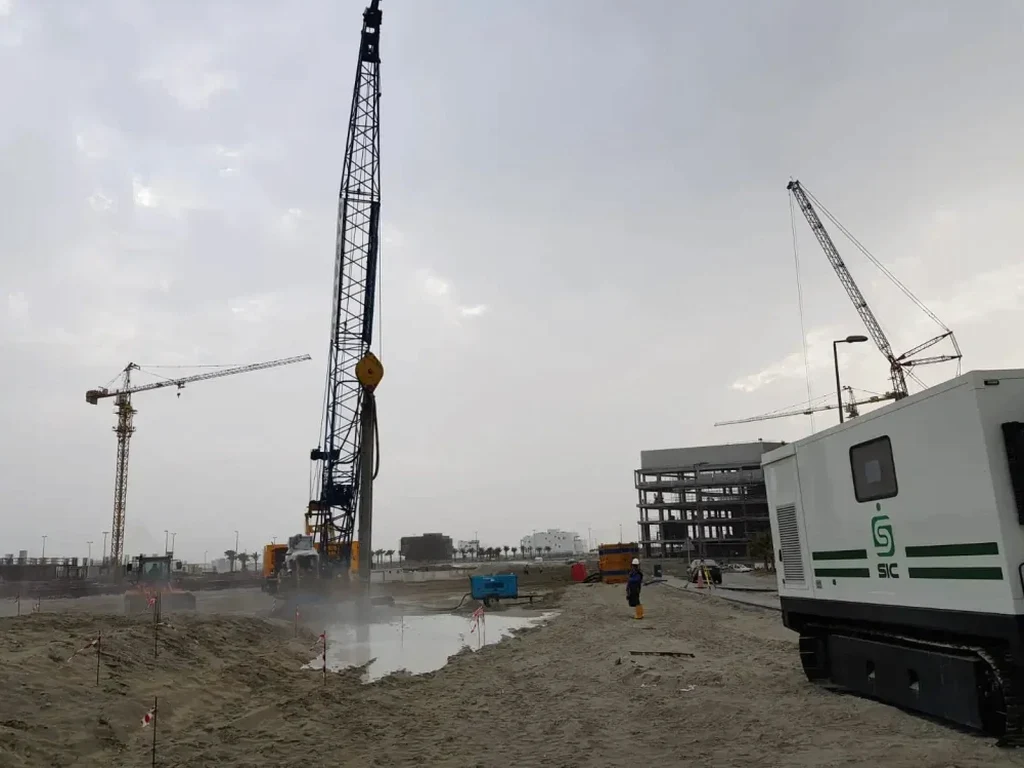
Risks and considerations in Basildon
The mistake we see repeatedly is treating vibrocompaction as a generic grid without adapting to the site's depositional history. Basildon's made ground often contains brick fragments, clinker, and occasional organic pockets from old drainage channels. Running a standard grid over an undetected soft spot densifies the surrounding material but leaves a weak column right where a pad footing might sit. We have also encountered sites where the water table sits within two metres of the surface and the contractor attempted dry bottom-feed compaction—the result was a messy, partially collapsed hole and zero improvement. The correct approach, under BS EN 1997-1, is to treat vibrocompaction as a design-and-verify process: model the expected improvement, instrument a trial zone, run post-treatment CPTs, and only then roll out the production grid. Skipping the trial phase on a £2 million industrial unit is a false economy that can cost the groundworks subcontractor their margin.
Our services
Our vibrocompaction design work in Basildon spans the full project lifecycle, from feasibility through to post-treatment sign-off. Every package is tailored to the specific ground conditions encountered on site.
Feasibility assessment and desk study
Review of historical borehole data, geological mapping, and nearby case histories to determine whether vibrocompaction suits the site's grain-size distribution and depth to competent strata.
Trial zone design and monitoring specification
Layout of a representative test area with defined grid geometry, probe penetration rate, and hold time at depth, plus instrumentation requirements for pore pressure and vibration monitoring.
Production grid and verification protocol
Full-site compaction plan with acceptance criteria tied to post-treatment CPT cone resistance and zone load test settlement limits, documented in a Ground Improvement Report for Building Control submission.
Common questions
Is vibrocompaction effective in Basildon's made ground and river terrace deposits?
Yes, provided the fines content is below about 15 percent. Basildon's river terrace sands and gravels respond well, and even some sandy made ground can be improved. Where silt layers exceed 300 mm thickness, we typically recommend a hybrid approach or switch to stone columns. A trial zone is essential to confirm performance before committing to a full production grid.
How much does a vibrocompaction design package cost for a typical Basildon site?
For a standard industrial or commercial plot in Basildon, the design package including feasibility review, trial zone specification, and production grid documentation typically ranges from £1,260 to £4,210, depending on site area and the complexity of the ground profile.
What verification testing do you require after vibrocompaction?
We specify CPT soundings at a rate of roughly one per 100 square metres of treated area, with at least three soundings crossing the trial zone. Cone resistance must meet the design target profile, and we usually request one zone load test on a 1 m square plate to confirm settlement performance under working load.
How close to existing structures can vibrocompaction be carried out safely?
Vibration monitoring is standard practice. We set peak particle velocity limits based on BS 5228-2 and the condition of adjacent buildings. In Basildon, where many industrial units share party walls, we typically maintain a minimum 3-metre standoff from sensitive structures and monitor with geophones during the trial phase. For distances under 3 metres, we generally recommend an alternative technique such as grouting.