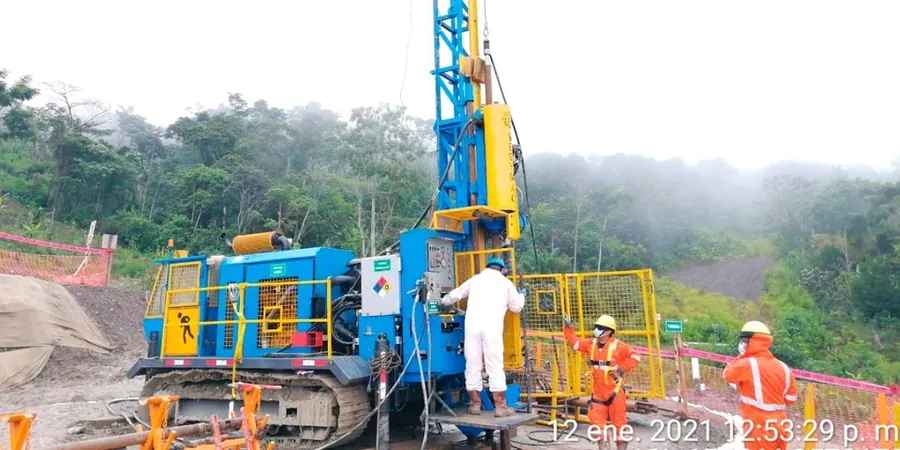
Basildon's development sits atop a complex geological mosaic: London Clay overlying the Lambeth Group and Thanet Sand Formation, with pockets of Head deposits and alluvium along the Crouch and Thames tributaries. The Standard Penetration Test remains the most widely specified in-situ investigation method across the town, from the industrial estates of Burnt Mills to the residential expansions around Laindon and Pitsea. A single borehole with SPT sampling can reveal the critical transition from weathered desiccated crust to competent clay at depth—a boundary that governs pile length, footing width, and excavation stability. By measuring blow counts every 1.5 metres in accordance with BS 5930:2015, we convert hammer impacts into engineering parameters that structural designers can trust. For deeper strata or continuous profiling where clay sensitivity is a concern, the CPT test provides complementary cone resistance data without disturbing the sample, especially useful when verifying the presence of silt lenses within the London Clay sequence.
Corrected SPT N-values in Basildon's London Clay correlate directly to bearing capacity—misinterpreting a single blow count can shift the foundation design from a shallow pad to a piled solution.
Methodology applied in Basildon
Risks and considerations in Basildon
Borehole records from the British Geological Survey show that Basildon's London Clay can soften significantly within the top 2 to 3 metres due to seasonal wetting-drying cycles, producing SPT N-values below 4 in winter months. A foundation designed on summer blow counts without accounting for this seasonal degradation risks unacceptable settlement. Equally hazardous are the sand lenses within the Lambeth Group, which can carry perched groundwater under artesian pressure; encountering one unexpectedly during boring without adequate casing can trigger a rapid inflow that destabilises the borehole walls. The town's location on the northern flank of the Thames Basin also means that relic shear surfaces from periglacial solifluction occasionally appear in the upper clay profile, reducing the mass strength to near-residual values. These features are invisible from the surface but reveal themselves through anomalously low SPT refusal depths, and missing them can lead to slope failures during basement excavations or cut-and-fill earthworks.
Our services
Every Standard Penetration Test campaign in Basildon comprises field logging, laboratory index testing on recovered samples, and a factual report presenting corrected N-values. The following complementary services further enhance the geotechnical model.
Geotechnical Interpretative Report with Foundation Recommendations
We transform SPT blow counts into allowable bearing pressures and pile capacities using established UK practice. The report includes settlement estimates, liquefaction screening where granular soils are present, and a clear statement of geotechnical risk aligned with the Basildon Borough Council building control requirements.
Combined SPT and Laboratory Testing Package
For projects requiring full parameter derivation, we pair SPT sampling with Atterberg limits, triaxial compression testing, and oedometer consolidation on undisturbed samples. This integrated approach satisfies the Designers' requirements under Eurocode 7 for Category 2 and 3 structures.
Common questions
How much does an SPT investigation cost for a typical house extension in Basildon?
For a single borehole to 10 metres depth with SPT sampling at 1.5 m intervals, laboratory classification testing on selected samples, and a factual report with corrected N-values, the cost ranges from £430 to £620 depending on access conditions, traffic management requirements, and whether the site falls within a Thames Water consultation zone. Projects requiring two boreholes or deeper investigation will fall at the upper end of this bracket or slightly above.
How many boreholes do I need for my Basildon project?
Eurocode 7 (BS EN 1997-2) ties the number of investigation points to the geotechnical category and building footprint. For a Category 2 residential structure under 200 m², a minimum of two boreholes is recommended—positioned to capture both the near-surface desiccated crust and any deeper soft zones. On larger commercial plots in the Basildon Enterprise Corridor, we typically specify a grid spacing of 20 to 30 metres, supplemented by dynamic probing if lateral variability is suspected.
Can SPT testing identify the risk of clay shrinkage and heave in Basildon?
Yes, and it is one of the most common reasons SPTs are commissioned on the London Clay outcrop. Low N-values combined with high plasticity index from laboratory tests on the split-spoon samples indicate a desiccated, shrinkable clay near the surface. We correlate the SPT profile with BRE Digest 240 methodology to assign a volume change potential classification, which directly informs the foundation depth specified by the structural engineer to avoid seasonal movement damage.