We see it too often in Basildon — a contractor specifies a standard anchor bond length without accounting for the slickensided surfaces in the local London Clay, and the first proof test fails at 60% of the design load. The clay here, particularly where it transitions into the Lambeth Group deposits across the A127 corridor, has a nasty habit of strain-softening under sustained tension. Active anchors in Basildon demand more than a textbook bond calculation; they need a site-specific assessment of the undrained shear strength profile and its sensitivity to remoulding during drilling. Passive anchors present a different challenge entirely, relying on the overburden pressure and clay stiffness to mobilise resistance — and in the weathered upper crust of the Claygate Member that underlies much of the town centre, that stiffness can drop by half within two metres of the surface. Our approach ties every anchor design back to factual site investigation data, which is why we always recommend pairing the anchor assessment with a CPT test to capture the continuous stratigraphy that rotary boreholes sometimes miss in the interbedded silts of the Thanet Sand formation.
Anchor bond capacity in London Clay is governed by the operational undrained shear strength, not the peak — ignore strain-softening and you underestimate creep by an order of magnitude.
Methodology applied in Basildon
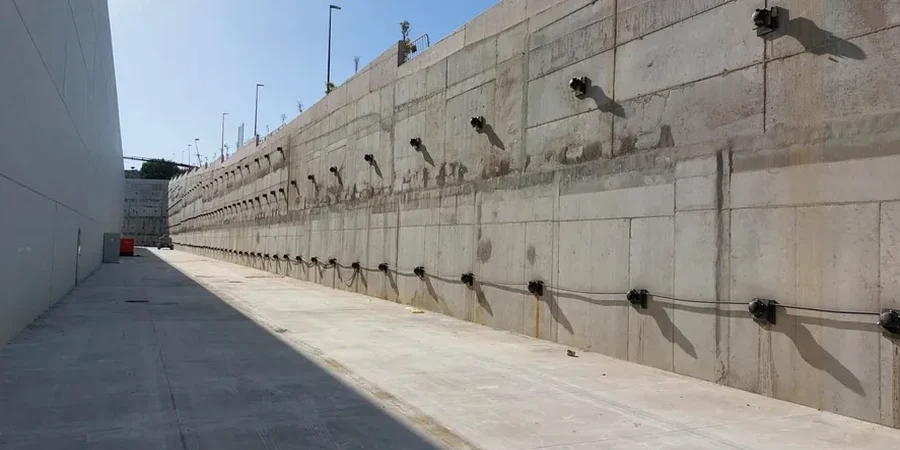
Risks and considerations in Basildon
A deep basement excavation on Southernhay in Basildon's town centre ran into trouble when the temporary works designer assumed passive resistance from the weathered London Clay without accounting for the relaxation that occurs during prolonged open-cut conditions. After three weeks of exposure — and two heavy rainfall events that November — the clay at the toe of the sheet pile wall had softened to the point where the passive wedge could no longer sustain the horizontal reaction required by the lowest row of anchors. The wall deflected inward by 85 mm before the contractor could install emergency berm support. This scenario plays out across the region because the London Clay's undrained strength is highly moisture-sensitive; even a 2% increase in water content can halve the undrained shear strength in the fissured upper zone. Our anchor designs for Basildon always incorporate a sensitivity analysis on the passive resistance, factoring in the worst credible groundwater scenario and the expected construction duration. For permanent works, we specify double corrosion protection regardless of the aggressivity classification, simply because the long-term performance data from the Transport Research Laboratory's sister sites in Essex show that stray currents from buried utilities can accelerate corrosion in ways the standard tables do not capture.
Our services
Anchor design in Basildon sits at the intersection of structural engineering and ground investigation — you cannot specify one without the other. The services below represent the two halves of the workflow we deliver for every project, from single-storey basement retainers to multi-level cut-and-cover structures.
Active Anchor Design and Proof Testing Protocol
Full active anchor design package covering tendon configuration, bond length calculation, free length determination per slip surface geometry, and a detailed proof testing specification aligned with BS 8081. We produce the anchor schedule, stressing sequence, and lock-off load recommendations — and we attend site during the first three proof tests to interpret the load-extension curves in real time against the predicted behaviour.
Passive Anchor and Deadman System Verification
Passive resistance analysis for deadman anchors, soil nail arrays, and sheet pile toe embedment in Basildon's layered clay-sand profile. The verification includes limit equilibrium assessment of the passive wedge geometry, Broms method calculations for short pile anchors in clay, and a serviceability check on deflections under working loads using p-y curve modelling calibrated to site-specific pressuremeter data.
Frequently asked questions
What proof test load is required for ground anchors under Eurocode 7?
Per BS EN 1537 and the UK National Annex to Eurocode 7, investigation tests on sacrificial anchors must be loaded to the lesser of 1.5 times the design load or 80% of the characteristic tendon strength. For production anchors, the acceptance test requires loading to 1.25 times the working load in increments, with creep monitored at each stage. In Basildon's London Clay, we typically specify a minimum creep rate of less than 1 mm per log cycle of time during the final hold period, measured over a 15-minute interval. If the anchor is in Thanet Sand, the creep criterion can usually be relaxed slightly because the granular material exhibits less time-dependent deformation, but we never drop below 2 mm per log cycle without a solid site-specific justification.
How much does anchor design and testing cost for a typical Basildon retaining wall project?
For a typical Basildon project with two to four anchors and associated proof testing, the design package and on-site testing supervision ranges from £950 to £3,120, depending on the number of anchors, the complexity of the ground profile, and whether investigation tests are required in addition to production acceptance tests. The cost includes the anchor schedule, bond length calculations, free length verification, proof test specification, and attendance during the initial testing phase. Additional anchors beyond the base scope are priced per anchor, and any requirement for extended creep monitoring or load cell instrumentation is quoted separately after reviewing the ground investigation data.
What is the difference between active and passive anchors in retaining wall design?
Active anchors are pre-stressed to a specified lock-off load after installation, which means they actively apply a force to the retained structure and control deflections from the outset. Passive anchors — sometimes called deadman anchors or passive soil nails — develop resistance only when the structure moves and mobilises the soil's shear strength. In Basildon, we specify active anchors for most permanent retaining walls exceeding 4 metres in height because the London Clay's creep behaviour under sustained passive loading can lead to accumulated deformations over the design life of the structure. Passive systems are more common in temporary works or in the Thanet Sand, where the dense granular material provides a stiffer passive response and the deflection required to mobilise resistance is typically less than 0.5% of the wall height.