Ground improvement in Basildon encompasses a suite of geotechnical techniques designed to enhance the engineering properties of soils at depth, increasing bearing capacity, mitigating settlement, and providing resistance to liquefaction. This category is critical for transforming marginal land into viable development platforms, directly supporting the region's ongoing residential and commercial expansion. In a town where large-scale regeneration projects are common, the ability to strengthen weak ground without the cost and carbon footprint of deep foundations or bulk earthworks is a fundamental enabler of sustainable construction. By modifying soil characteristics in situ, developers can meet strict performance criteria while preserving site topography and reducing off-site disposal of unsuitable material.
The local geology of Basildon presents a complex interplay of Quaternary deposits overlying the London Clay Formation and, in lower-lying areas, significant thicknesses of alluvium and river terrace gravels. Much of the town’s development land is underlain by soft, compressible silts and clays, often with high organic content, which are prone to long-term consolidation settlement and have low undrained shear strengths. These conditions are particularly prevalent in the floodplains of the River Crouch and its tributaries, where groundwater levels are high and soils can be fully saturated. Such ground profiles demand careful assessment, as conventional shallow foundations are frequently inadequate, making specialist ground improvement not merely an option but a necessity for safe, durable construction.
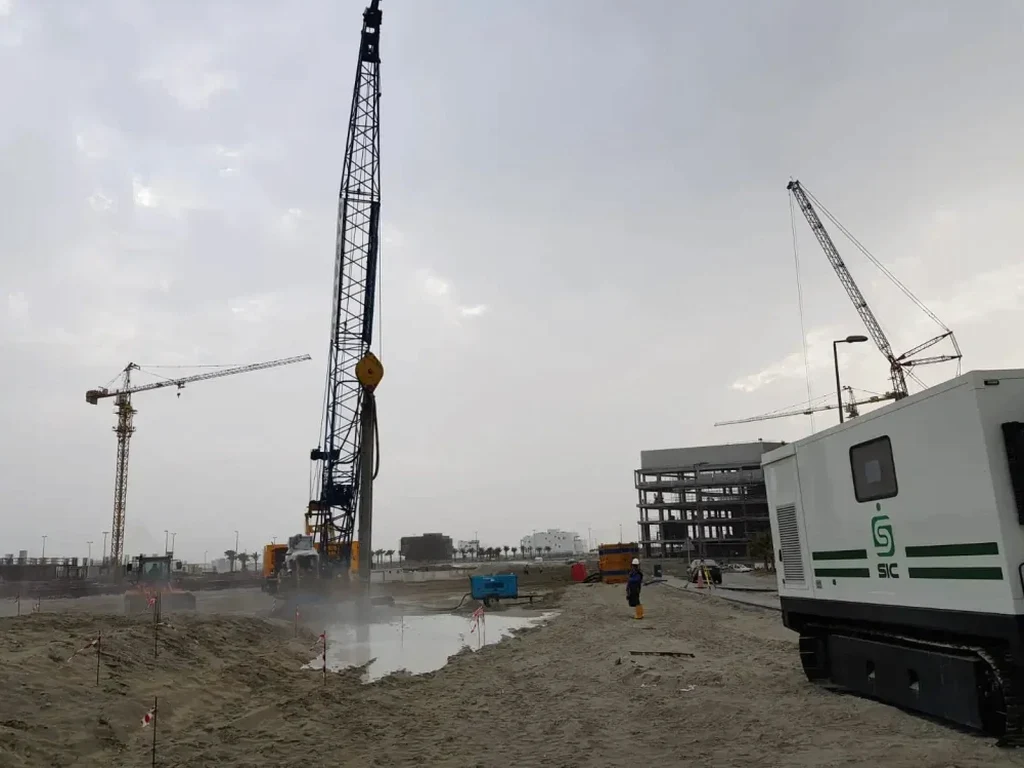
All ground improvement works in Basildon must comply with the overarching framework of the Building Regulations 2010, specifically Approved Document A (Structure), which mandates that foundations and subsoil be capable of safely sustaining imposed loads without excessive movement. The execution of these works is governed by British Standards, most notably BS EN 1997-2 (Eurocode 7 – Geotechnical design – Ground investigation and testing) and the execution standard BS EN 14731 for deep vibration techniques. The specification and verification of improved ground are typically aligned with the principles of BS 8004 (Code of practice for foundations) and the ICE Specification for Ground Treatment, ensuring that design assumptions are rigorously validated through post-treatment testing such as cone penetration tests (CPT) and zone load tests. Local planning authorities, including Basildon Borough Council, will often require a detailed geotechnical design report as a condition of approval for major developments.
The range of projects requiring ground improvement in Basildon is diverse, spanning from low-rise housing estates on reclaimed marshland to large-footprint industrial warehouses and infrastructure corridors. Residential developments frequently encounter soft alluvial clays where engineered solutions like stone column design are employed to create stiffened composite ground capable of supporting strip and pad footings. For granular deposits that are loose and potentially liquefiable, particularly in areas of former gravel workings, vibrocompaction design provides a rapid and effective method of densification, significantly increasing relative density and friction angle. Commercial projects, such as retail parks and logistics centres, often require a hybrid approach, combining techniques to address variable ground profiles across a single site. Infrastructure works, including road embankments and drainage schemes, also rely heavily on these methods to control total and differential settlement.
Available services
Common questions
What is ground improvement and when is it necessary in Basildon?
Ground improvement refers to the controlled modification of soil properties to enhance strength, stiffness, and permeability. It becomes necessary in Basildon when site investigation reveals soft alluvial clays, loose silts, or made ground that cannot support proposed structural loads without excessive settlement or bearing capacity failure. It is a common alternative to deep piled foundations on sites with challenging ground conditions.
Which British Standards regulate ground improvement works in the UK?
Key standards include BS EN 1997-2 for geotechnical design and ground investigation, and BS EN 14731 for the execution of deep vibration techniques. The ICE Specification for Ground Treatment provides a robust framework for method statements and quality control. Compliance with these standards, along with the Building Regulations 2010, is mandatory for ensuring treated ground meets design assumptions.
How is the performance of improved ground verified after treatment?
Verification typically involves a combination of in-situ testing and monitoring. Post-treatment cone penetration tests (CPT) are used to measure increases in tip resistance and sleeve friction, while zone load tests can confirm modulus of deformation and settlement behaviour. The specific testing regime is defined in the design specification and must demonstrate compliance with the acceptance criteria set out in BS EN 1997-2.
Can ground improvement be used for both residential and industrial projects?
Yes, it is highly adaptable. For residential projects, techniques like stone columns are used to support strip footings on soft clays. For large industrial warehouses or infrastructure with heavy floor loads and wide footprints, vibrocompaction or a combination of methods can be specified to control differential settlement and improve bearing capacity uniformly across the site, meeting stringent performance requirements.