The ground beneath Basildon tells a story that directly shapes how we build here. The town sits atop the Lambeth Group deposits, a sequence of stiff clays, sands, and gravels that transitions into the underlying Thanet Sand Formation and Chalk bedrock at depth. In our experience, this layered stratigraphy creates a specific challenge: the upper weathered clays desiccate and shrink during dry summers, while the deeper sands can densify under load, making shallow footings a risky proposition on many plots. We see this pattern consistently across the Vange and Laindon areas, where variable ground conditions demand a solid pile foundation design approach. Rather than guessing at bearing depth, we correlate borehole recovery data with SPT N-values to pinpoint the competent stratum, typically targeting the dense Thanet Sand or Chalk to transfer structural loads safely below the zone of seasonal volume change. This is not about applying a generic formula; it is about reading the ground carefully and designing a piled solution that works with the local geology, not against it.
In Basildon, the difference between a pile that settles 5 mm and one that settles 25 mm often comes down to how accurately you characterised the Lambeth Group transition zone.
Methodology applied in Basildon
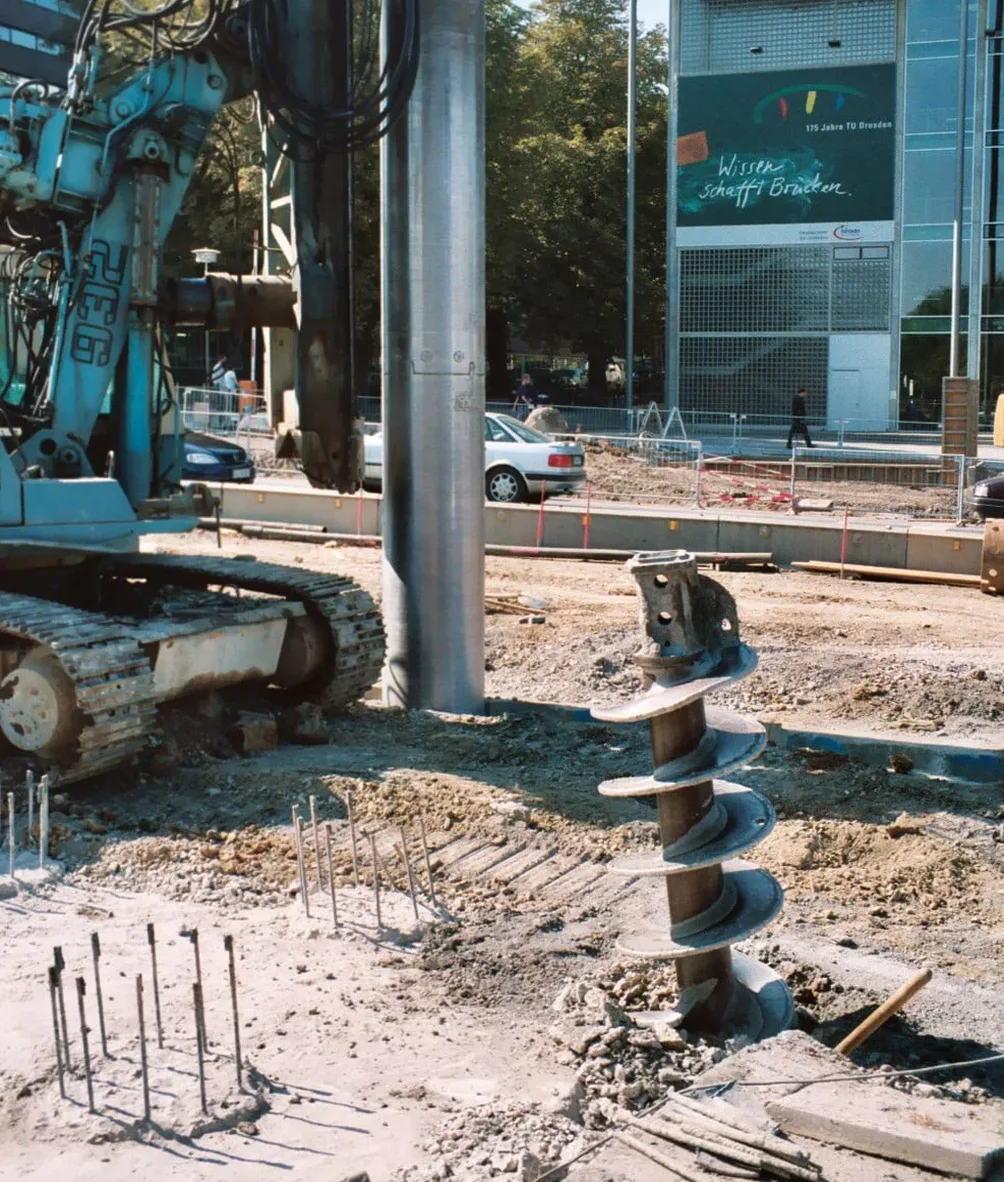
Risks and considerations in Basildon
With a population exceeding 115,000, Basildon continues to densify, and we are seeing more projects proposed on marginal land that previously would have been left undeveloped — former industrial plots near the A127 corridor, infill sites in Pitsea, and extensions on sloping ground toward the Langdon Hills. These sites carry hidden risk. Made ground thickness can exceed 2.5 metres in redeveloped areas, and where it contains organic or rubble fill, negative skin friction becomes a real design concern that can strip away 30% or more of a pile's geotechnical capacity if not accounted for. We also watch for shallow groundwater perched on the clay, which can create temporary instability during pile boring and increase the risk of necking in uncased CFA piles. A pile foundation design that ignores these site-specific hazards will look fine on paper but fail in the ground. We build these scenarios into the load case analysis from day one, including downdrag forces and lateral spreading checks where adjacent slopes exceed a 1:6 gradient.
Our services
Our pile design work in Basildon covers the full project lifecycle, from feasibility advice through to construction-phase support. We tailor the approach to the site geology and the structural demands.
CFA and Driven Pile Design
Full geotechnical design of continuous flight auger and driven pile systems for residential plots and low-rise commercial buildings. We provide pile schedules, setting out coordinates, and settlement predictions derived from SPT or CPT field data correlated to the Thanet Sand formation.
Pile Load Test Specification and Interpretation
We draft static and dynamic load test specifications aligned with ICE guidelines and interpret the results to validate or refine the design parameters. This is particularly valuable on Basildon sites where the Lambeth Group clay strength varies laterally over short distances.
Common questions
What depth of pile is typically needed for a house extension in Basildon?
It depends entirely on the ground investigation findings, but in central and north Basildon we often design piles to found in the dense Thanet Sand at depths between 12 and 18 metres. On some elevated sites near Langdon Hills, competent Chalk may be reached shallower. We never specify a depth without borehole data because the Lambeth Group surface can undulate significantly.
How much does a pile foundation design cost for a typical Basildon project?
Design fees for a single dwelling typically range from £1.150 to £5.170, depending on the number of piles, the complexity of the ground profile, and whether load testing or additional CPT verification is required. The fee includes the interpretive report, pile schedule, and coordination with the structural engineer.
Do you need to test the piles after installation?
Yes, and this is something we strongly recommend. A static load test or high-strain dynamic test provides the ultimate verification that the pile behaves as predicted. On Basildon sites with variable Lambeth Group conditions, we often specify one preliminary test pile per structure to confirm shaft adhesion assumptions before production piling begins.
Can piles be installed close to neighbouring buildings in Basildon?
In most cases, yes, but it requires careful sequencing and vibration monitoring. For tight-access sites, we commonly specify CFA piles because the augering process generates significantly less ground-borne vibration than driven piling. We work with the piling contractor to set trigger action levels for vibration and settlement and include these in a method statement submitted to building control.
What happens if the ground contains obstructions or old foundations?
This is a realistic scenario on Basildon's brownfield plots. We begin by reviewing historical maps and any prior site investigation reports. If obstructions are suspected, we may recommend a pre-auger probe or a sacrificial pilot hole. In the design, we account for potential refusal above target depth and specify a contingency strategy — often a revised pile layout or a switch to a steel-cased auger system to cut through debris.