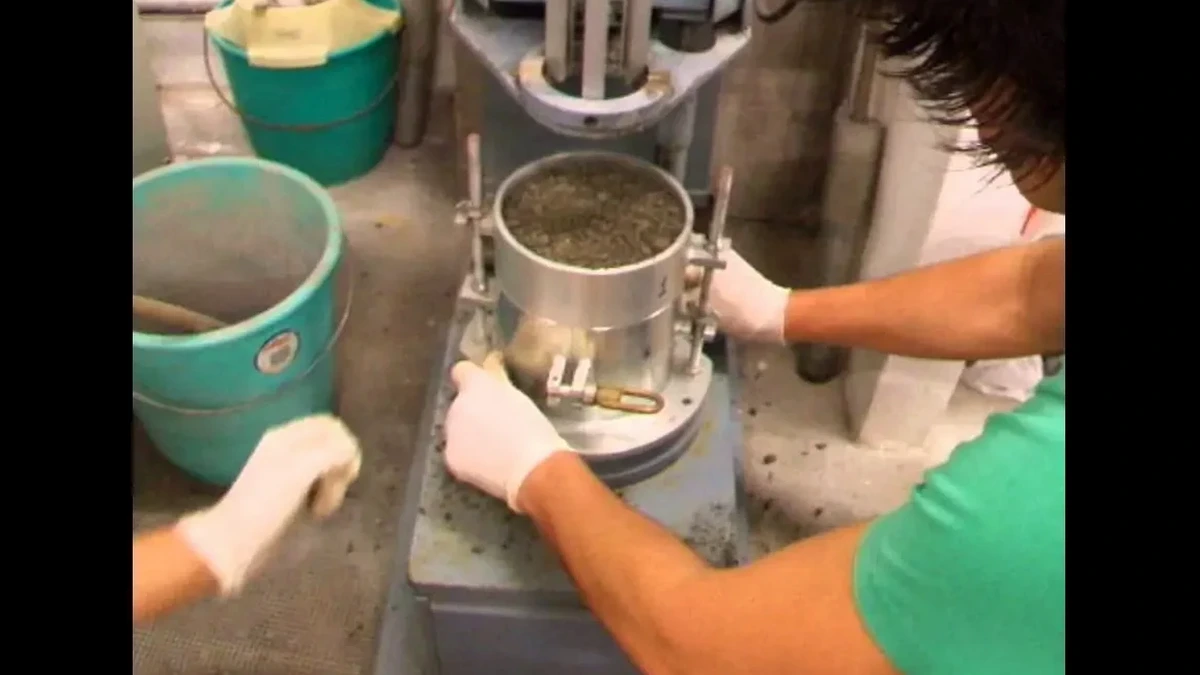
Basildon sits on a thick mantle of London Clay Formation with pockets of Head deposits and River Terrace Gravels along the Crouch and Thames corridors. On most sites we visit, the natural clay moisture content sits stubbornly above optimum, which means placing structural fill without a proper Proctor reference is a gamble nobody on site can afford. The Proctor test defines the maximum dry density and optimum moisture content for a given soil, and in this part of Essex the difference between 92% and 98% relative compaction is the difference between a stable embankment and one that settles unevenly within two winters. We run both BS Light (2.5 kg rammer) and BS Heavy (4.5 kg rammer) compactive efforts depending on the plant specification and end use, and we tie the lab curve directly to field control with the sand cone density method so the ground team has a live compaction target, not just a number on a report. When granular fill is imported from quarries in the Chelmsford area, we often pair the Proctor work with a grain size analysis to confirm the material is within the specification envelope before compaction trials begin.
Compaction without a Proctor curve is just guesswork with a roller. The lab gives the target, the field density test tells you if you hit it.
Methodology applied in Basildon
Risks and considerations in Basildon
Basildon was designated a New Town in 1949 and the post-war expansion pushed residential estates and industrial parks onto clay plateaux that had never carried engineered fill at that scale. Decades later, extensions and brownfield redevelopments are going in right next to those original earthworks, often with tighter serviceability limits for modern structures. The biggest hazard we encounter is differential settlement caused by fill placed dry of optimum in the 1960s and 1970s, before Proctor-based specifications were routinely enforced on housing plots. When we test a redevelopment site, we sample the existing fill, run a Proctor on it, and compare the in-situ density via sand replacement to assess whether it can stay in place or needs to be stripped and re-compacted. Collapse compression on wetting is another mechanism we watch for in Basildon: clay fills compacted at low moisture content can lose significant volume when groundwater rises, and only a proper Proctor reference with a saturation check will flag that risk before services and slabs go in.
Our services
Our Proctor work in Basildon is always run as part of a wider earthworks control package because the lab curve means nothing without field verification on the same material. The services below are the ones we most frequently combine with compaction testing on Essex sites.
Sand replacement density testing
In-situ density by the sand pouring cylinder method to BS 1377-9, run on the same fill material used for the Proctor curve. We test at formation level and each lift to confirm the specified relative compaction is achieved before the next layer goes down.
CBR laboratory and field testing
California Bearing Ratio determination at the Proctor optimum moisture content, plus in-situ CBR on compacted subgrade. Essential for pavement design on Basildon's residential access roads and industrial estate yards.
Atterberg limits and particle size distribution
Classification testing to BS 1377-2 that tells us the plasticity and grading of the fill before we select the correct Proctor method. High-plasticity London Clay often requires lime modification, and the Atterberg limits guide that decision.
Frequently asked questions
What is the difference between BS Light and BS Heavy Proctor, and which one do I need for a Basildon housing estate road?
BS Light Proctor uses a 2.5 kg rammer with a 300 mm drop and is specified for most general fill and landscaping applications. BS Heavy Proctor uses a 4.5 kg rammer with a 450 mm drop and is required for highway subgrade and structural fill under the MCHW Series 600. For a residential estate road in Basildon, the adopting authority almost always specifies the Heavy method with a minimum of 95% relative compaction on the capping and subgrade layers. We can confirm the exact requirement against the Section 38 or Section 278 agreement before testing begins.
How much does a Proctor compaction test cost in Basildon, and what does the price include?
A single Proctor determination (five-point curve, Light or Heavy) typically falls between £70 and £190 depending on whether we run it on a 1-litre mould or a CBR mould and whether the material requires moisture conditioning. That price covers sample preparation, compaction, moisture content determination on each point, the plotted curve, and the test report with the maximum dry density and optimum moisture content. Volume discounts apply when we batch multiple Proctors as part of an earthworks monitoring programme.
How long does it take to get Proctor test results, and can you do it on site?
A full five-point Proctor curve takes one working day in the laboratory because the sample needs oven drying at each moisture increment to plot the curve accurately. We can provide a rapid one-point Proctor on site using a nuclear gauge correlation for preliminary guidance, but the definitive result for specification compliance always comes from the lab procedure to BS 1377-4. For time-sensitive Basildon projects we run samples overnight and have the report ready by the next morning's site briefing.