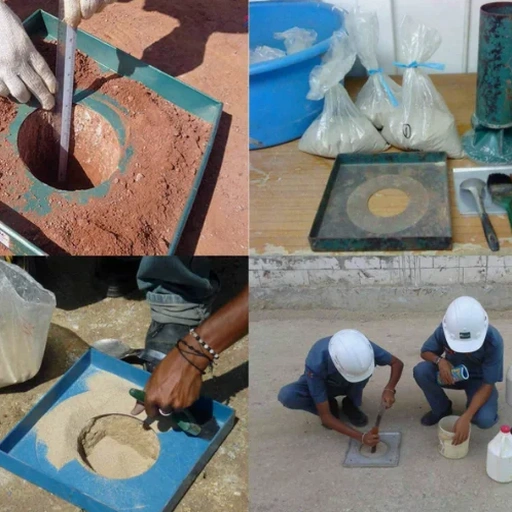
Basildon sits on a mix of London Clay, Thanet Sand, and pockets of river terrace gravels, with a water table that can rise quickly after a wet winter. The clay shrinks and swells with seasonal moisture changes, and the gravels can be surprisingly loose just below the topsoil. We see this pattern across the town, from Laindon to Pitsea. Compaction control here is not a box-ticking exercise. A field density test using the sand cone method gives a direct measurement of in-place density on compacted fill, trench backfill, and subgrade layers. When earthworks are placed over variable natural ground, test pits help us check layer boundaries and identify soft spots before density testing begins. In Basildon's heavier clays, achieving the specified relative compaction often requires careful moisture conditioning, and the sand cone test confirms whether the roller work actually delivered the required result.
A sand cone test on London Clay fill that passes density but fails moisture content will still cause long-term pavement distress in Basildon's wet winters.
Methodology applied in Basildon
Risks and considerations in Basildon
On a commercial plot near Festival Leisure Park, we tested a capping layer placed over reworked clay fill. The top 100 mm passed density easily, but the underlying 300 mm was 8% below the specified relative compaction. The contractor had increased lift thickness to save time, and the roller was not compacting the full depth. In Basildon, where much of the new development sits on gently sloping ground with made ground history, this scenario repeats more often than designers expect. A single sand cone test only represents the layer depth you excavate. If fill is placed in lifts thicker than 200 mm, the bottom of the lift may remain uncompacted, setting up differential settlement under floor slabs or asphalt. We recommend pairing density testing with in-situ permeability checks when the fill will also act as a drainage blanket or when water ingress through the formation could soften the clay beneath.
Our services
Field density verification is one part of a broader compaction control and earthwork quality assurance programme. The services below are the ones most frequently combined with sand cone testing on Basildon projects.
Sand Cone Density Testing (BS 1377-9)
In-place density measurement on compacted fill, trench backfill, subgrade, and capping layers using the calibrated sand pouring cylinder method. Results reported as dry density and relative compaction against Proctor reference.
Laboratory Proctor and Moisture-Density Relationship
Standard and modified Proctor compaction tests to establish the maximum dry density and optimum moisture content for Basildon's natural and imported fill materials. Essential reference for field density acceptance.
CBR and Plate Load Testing
California Bearing Ratio testing on formation and capping, plus plate bearing tests for modulus of subgrade reaction. Used to validate pavement design assumptions after density acceptance is achieved.
Frequently asked questions
How much does a sand cone density test cost in Basildon?
A single sand cone field density test in Basildon typically ranges from £70 to £120, depending on the number of tests per visit and site location. Mobilisation costs may apply for small test programmes. Contact us with your earthwork volume and specification, and we will provide a clear quote based on BS 1377-9 requirements.
How many sand cone tests are required per lift?
The minimum frequency is defined in the project specification, commonly one test per 250 to 500 square metres per compacted lift, or one test per 50 linear metres of trench backfill. In Basildon's variable ground conditions, we often recommend a slightly higher frequency on the first lift to establish a reliable compaction baseline before reducing the rate on subsequent layers.
Can the sand cone method be used in wet or granular soils?
The sand cone method works reliably in most soils encountered in Basildon, including clay, silt, and sand-gravel mixtures. In fully saturated or very loose granular soils, the test hole may collapse before the sand is poured. We mitigate this with template plates, pre-drying the hole sides, or switching to a nuclear density gauge where permitted by specification. The method is not suitable for soils with significant coarse gravel or cobble content above 37.5 mm without particle correction.